Posted with permission from
the International Society for Bipolar Disorders (ISBD), The Global, Volume
5, Issue 2 (2004)
The Benefits of Healthy Recovery Groups
In this fourth and last article on recovery groups, we
examine the benefits of healthy recovery groups. Recovery groups can have a
major impact in helping a person live well with bipolar disorder. They provide
opportunities for learning and for being part of a unique, supporting
community. Recovery group members quickly learn that helping others reinforces
one’s own progress and empowers people to go forward in seeking wellness. For
recovery group leaders, providing the structure for members to help others is
perhaps the greatest benefit of recovery groups.
Using Educational Opportunities
Learning occurs on many levels. It can be fast or slow,
painful or fun. Learning by leaps and bounds involves exposure to basic
knowledge about bipolar disorder. A group experience allows you to access the
knowledge base of guest speakers and of everyone in the group.
Becoming expert in living with bipolar disorder helps you succeed. Such
expertise helps you utilize the benefits of treatment and community resources.
With it, you can become a creative user of tools that will help you address
challenges of living with bipolar disorder. A practical knowledge base about
bipolar disorder helps you enhance your ability to identify and
strengthen your unique qualities.
In the first article of this series three essential values of recovery were
introduced. Now is a good time to review them.
1. Recovery is possible
2. Recovery skills can be learned
3. Often recovery skills are best taught by those who have integrated them into
daily life
In seeking mental wellness, we do
not always follow the same path, but seeing the road map
of other’s
experience can help us choose our route and make sure we are headed in the
right
direction.
Being Part of a Community
Every community has distinguishing characteristics. For
recovery groups the unique message is that we are not alone in experiencing the
challenges of bipolar disorder. Healthy groups empower individuals to tackle
challenges that accompany bipolar disorder by teaching recovery skills. They
invite members to join with others who have entered the process of recovery.
Do you remember the definition of recovery from the first article in this
series? “Recovery is the process of actively seeking mental wellness in the
context of experiencing bipolar disorder” (Mountain, 2003).
Strong and rapid growth in any process requires feedback from others. In a safe
environment, provided by a recovery group, feedback from others can help you to
see yourself more objectively. Having this view can readily reinforce your
strengths even when you are frustrated and discouraged. It can also help you
develop a realistic picture of who you really are when you are riding the waves
of mania.
The message of group members who see strengths and progress toward recovery
provides an alternative to the message of depression that screams lies about
inadequacy. Seeing your progress through the eyes of others who have walked in
your shoes is an antidote to the message you may be hearing from society that
emphasizes an illness you experience rather than recognizing your unique gifts
and personality.
In a recovery group setting, the success of other members nurtures hope.
Watching others hit a low or a peak and then come back to stability gives
perspective about our own walk with bipolar disorder. This give-and-take brings
a better understanding about what living with bipolar disorder is all about.
Helping Others
Finding opportunities to help others may well be the most
important benefit of being part of a recovery group. Helping others reinforces
our own strengths and our progress toward wellness, and teaching others what we
have learned causes us to reflect on our own progress. The steps shown in the
diagram below illustrates how the dynamic of applying recovery principles
brings the recovery process full circle.
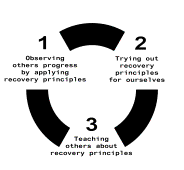
This dynamic process can be fostered in any recovery group. It begins by
establishing a safe place where all are asked, “What are you doing to take care
of yourself?” This is followed by giving encouragement and by active problem
solving.
Part of this process is insuring leaders are receiving as
much support as others in the group. If you are a group leader, there may
be times when you feel as though you are only giving support without receiving
it. You can address this at the appropriate time during each meeting by stating
that it is your turn to share and get support and letting others know in your
conversations that you value their support. Failing to teach this principle
leads to leadership burnout. More importantly, it bypasses a means to allow all
members of the group to become active in helping others.
When leaders are not supported, it reinforces the perception that recovery is
an ideal that a few leaders have reached rather than a process that is
obtainable by all. Group members are helped when they learn they have a
valuable contribution to make— even to identified leaders of the group.
Healthy Recovery Groups Offer Benefits
Three essential benefits of a healthy recovery group are
1. The facilitation of education about bipolar disorder with
the goal that group members become
experts
about bipolar disorder.
2. The creation of a safe community in which members are not alone in meeting
the challenge to
live well with bipolar disorder.
3. The presentation of opportunities for members to help
others in order to reinforce the recovery
process
and to see recovery as an obtainable goal